How Long Website Development Takes: Timelines by Type and Plan
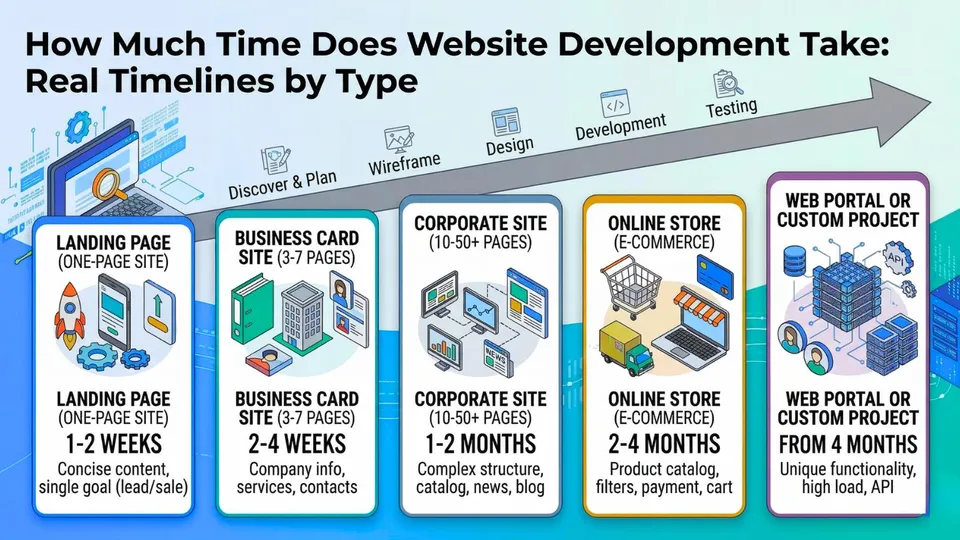
In our packages a landing page takes 3–10 days, a business website 5–35 and an online store 15–60. But a project calendar is not made of build hours alone. Copy, approvals and launch take a big share of it, and they usually decide when the site actually goes live.
Below: a table of timelines by type and package, what they consist of, what to prepare before kickoff and what still happens after launch.
Timelines by type and package
Every figure in the table comes from our packages as of the publication date. These are ranges in days, not a “ready in three days” promise: price and timeline are fixed in the contract once the scope is agreed, and tasks outside the package are quoted separately. For landing pages we count the timeline on the condition that materials are ready.
| Type | Package | Scope | Timeline | Price |
|---|---|---|---|---|
| Landing page | Start | one page, up to 7 sections | 3–5 days | $250 |
| Landing page | Business | up to 12 sections, structure and copy, online payment, 2 languages | 3–7 days | $400 |
| Landing page | Pro | CRM integrations, 3 languages, 2 A/B-test variants, Google Ads launch | 5–10 days | $650 |
| Business website | Brochure | up to 5 pages | 5–7 days | $350 |
| Business website | Business | up to 15 pages, blog, CMS for services and cases, 2 languages | 14–21 days | $750 |
| Business website | Pro | up to 50 pages, staff roles, online booking, 3 languages, SEO package | 21–35 days | $1250 |
| Online store | Start | up to 50 products, one payment system | 15–25 days | $750 |
| Online store | Business | up to 500 products, Excel and YML import, payments and Nova Poshta, CRM | 25–35 days | $1150 |
| Online store | Pro | up to 5000 products, customer account, loyalty, ad integrations | 35–60 days | $1950 |
| Web portal, web app | by scope | accounts, roles, APIs, complex logic | after the brief | from $2000 |
Source: Veb-Dev packages and service pages, prices in US dollars. Food delivery sites use the same ranges (15–25, 25–35 and 35–60 days), priced from $850 to $2050.
How to read the table
Landing page. A single page goes through the same stages as a large site, just shorter: structure, design, responsive build, a lead form with analytics, testing. That is why 3–10 days is realistic only when copy, logo and access are already in hand. In the Business package, structure and copy are part of the work, which removes the main cause of delays. If the goal is to test demand fast or run ads, landing page development without “extra” pages that are not in the plan fits best.
Business website. The timeline climbs in steps: 5–7, 14–21, 21–35 days. Each step is added by pages, a blog, CMS sections (services, cases, team), languages, roles and online booking. In practice, count unique templates rather than pages: twenty service pages on one template are a content task, not twenty layouts.
Online store. The spread is the widest, 15–60 days, because the scope differs: from 50 to 5000 products, one payment system or three, CRM, customer accounts. Our advice: what takes longest in a store is usually data, not code. Names, prices, photos and stock levels in one consistent format take longer to gather than the catalog takes to build.
Web portals. A universal timeline makes no sense here. We set it after the brief and an assessment of features and risks, and fix it in the contract together with the price.
A hypothetical example: estimating it yourself
These are made-up scenarios, not real clients. First: a beauty studio needs an 8-page site with a blog and two languages. By scope that is the Business package for sites (up to 15 pages, blog, 2 languages), so 14–21 days. Add online booking and a third language and it becomes Pro: the lower bound moves from 14 to 21 days, the upper from 21 to 35. One item on a wish list shifts the calendar by a week or more.
Second: a store with 120 products, Nova Poshta delivery and a connected CRM. Start ends at 50 products, so this is Business (up to 500 products, Nova Poshta, CRM): 25–35 days rather than 15–25. So go into the conversation with a contractor holding three numbers: pages or products, languages, and the list of integrations.
What the stages are
- 1Briefing, strategy and contractwe fix the plan, timeline and price
- 2Structure and designkey screens approved before development
- 3DevelopmentCMS, forms, analytics and the services you need
- 4Testing and releasespeed, mobile version, forms, SEO; the studio founder reviews before handover
- 5Project handoveraccess plus an explanation of how to update content
Source: Veb-Dev work process
Our view: development is the most predictable stage because it depends on the team. The schedule slips at stage two, which needs your copy and decisions, and at stage four, where revisions pile up.
What most often stretches the calendar
- Late or partial copy. Design and build either wait for the final content or get redone.
- Approvals without a deadline. “One more colleague will take a look”, and a week is gone.
- Scope changes along the way. A new page, a different catalog structure, an extra language: that is a different estimate.
- Access. Domain, payment provider accounts, Nova Poshta keys, CRM.
- No single decision maker. Feedback arrives from three people and contradicts itself.
What to prepare before kickoff
This checklist shortens the timeline the most. It is our recommendation, not a requirement:
- Logo, brand colors, photos and materials that will definitely go on the site.
- Copy, or a brief for it: services, benefits, prices, contacts, answers to common questions.
- For a store: a file with products (name, price, photo, attributes, stock).
- Access to the domain and accounts of payment and delivery services. Apply for the payment system at the very start, since the review happens on their side and does not depend on us.
- One responsible person with the right to say “approved”.
After launch: what else takes time
A live site does not mean visible results yet. A few things are worth building into the plan.
Indexing. According to Google Search Central documentation (updated in December 2025), crawling after a request can take a few days up to a few weeks, and repeated requests for the same URL do not speed it up. So do not count on a first Google lead on launch day.
Speed measurement. PageSpeed Insights shows real-user data for the previous 28 days. A new site will not have such data at first, so lab tests are what you can look at. Google’s reference points for real-user experience: LCP up to 2.5 seconds, INP up to 200 milliseconds, CLS up to 0.1 at the 75th percentile of visits (per web.dev).
Mobile version. Google indexes the mobile version, so text, meta tags and markup should match on phone and desktop. We check the mobile version before release, and it is worth rechecking after every major edit.
Moving an old site. If you are redesigning with new URLs, Google advises keeping 301 redirects for at least a year, and new URLs typically need several weeks or more to replace the old ones in results (documentation, as of August 2026). For small and medium sites Google recommends moving all URLs at once.
DNS. Before pointing the domain to a new server, Cloudflare advises lowering record TTLs 24–48 hours ahead and uses 300 seconds as a typical value. The switch then spreads faster, and launch does not turn into waiting.
Free post-delivery support depends on the package: 2 weeks, 1 month or 2 months. Small fixes after the first real traffic are normal, and that period exists for them.
How to judge a timeline in a vendor’s offer
This is our assessment, not a market standard. Be wary if:
- the timeline is named without a scope: how many pages, languages, integrations;
- the contract has no stages and does not say who prepares the copy;
- a multi-page site or a store is promised “in 1–2 days”;
- the plan has no separate testing on a phone;
- it is unclear what happens if the scope changes.
A good offer gives the timeline as a range, ties it to conditions (materials ready, approval turnaround) and says plainly what falls outside the package.
What to do next
Gather the checklist above, pick a type from the table and name one person who approves. What remains is to settle the scope, and the timeline becomes a concrete date in the contract.
Want an estimate for your project? Get in touch: we will go through scope and stages and give you a realistic range.
Author: Sergey Filatyev, founder of the Veb-Dev boutique studio.
Tags
- how long website development takes
- landing page development timeline
- corporate website how long
- ecommerce development timeline
- web project schedule
- website launch planning