Landing Page or Corporate Site: Four Questions to Help You Choose
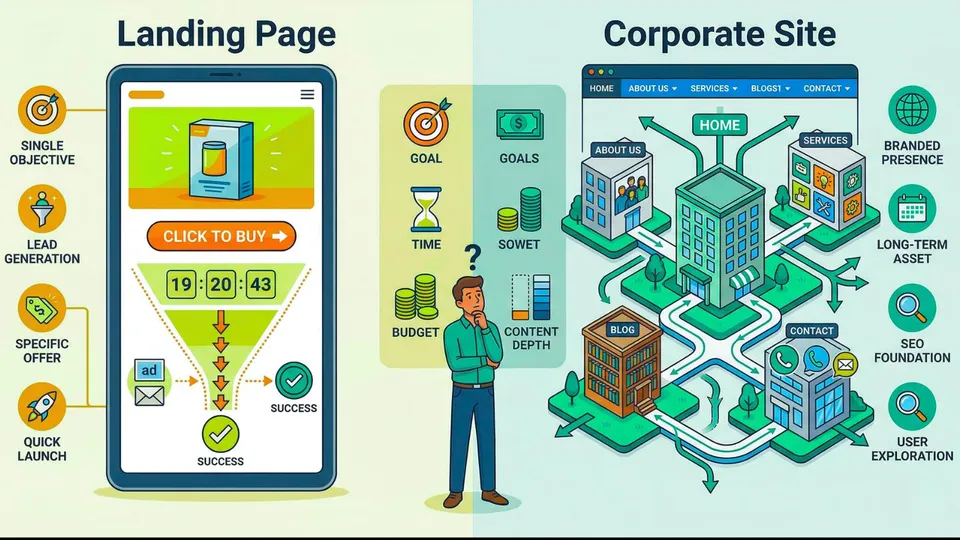
Landing pages and corporate sites are usually compared on price, but two other questions decide the choice: what single action a visitor should take, and where that visitor comes from. Ads bring traffic to a one-offer page quickly, while trust and search visibility build up over months and need a proper site structure. Below: criteria, what Google and Google Ads check, our prices and timelines, and a contract checklist.
How the two formats differ
A landing page is typically a single page (or a short funnel of a few steps) built around one goal: a lead, booking, payment or signup. Traffic is mostly paid or tied to one campaign, with few distracting links.
A corporate website is multi-page: company, services, case studies, contacts, sometimes a blog. It answers “who are you” and “what do you do,” and it is the base for SEO and repeat visits. It does not have to be a portal: 5–15 focused pages are often enough.
The labels are loose: some vendors sell a “landing page” with five subpages, others a “corporate site” that is one long scroll. Structure and traffic sources matter more than the name.
Side-by-side comparison
| Criterion | Landing page | Corporate site |
|---|---|---|
| Main goal | One action: lead, booking, payment | Trust, explaining the business, covering different queries |
| Typical traffic | Ads, email, narrow campaigns | Search, direct visits, referrals |
| SEO | One page for a narrow query, usually supports a main site | Separate pages for services, cities and informational queries |
| Scope at Veb-Dev | One page, up to 7–12 sections | Up to 5, 15 or 50 pages depending on the plan |
| Price and timeline at Veb-Dev | from $250, 3–5 days | from $350, 5–7 days |
| Main risk | No traffic means an empty page; a weak offer burns ad spend | Paying for sections nobody fills in |
What ads and search actually look at
In Google Ads, search ad quality is built from three components: expected CTR, ad relevance and landing page experience. Each component is rated “above average,” “average” or “below average” against advertisers who showed ads for the same search over the previous 90 days. Quality Score itself is a diagnostic metric and does not enter the auction, according to Google Ads Help.
Google describes landing page experience through usefulness and relevance, ease of navigation, the number of links, and whether the page matches what people expect after the click. Its advice is simple: keep the ad and the page consistent, and make the page work on a phone and load quickly.
In practice, it is easier to build a dedicated landing page for each ad offer than to bend the home page of a large site around it. On a landing page the ad, the headline and the button say the same thing.
Search visibility moves more slowly. Google’s starter guide notes that some changes take effect within hours and others take several months. So a corporate site pays back with a delay, while ads sent to a landing page give you first data within weeks. That is our estimate, not a guarantee for every niche.
There is also a trap: “a separate landing page for every city.” Google’s spam policies describe doorway pages: near-identical pages aimed at particular regions or cities that merely funnel visitors to one place. Our advice: a city page is justified only when it carries its own useful information, such as addresses, terms and reviews, not a swapped word in a template.
What it costs: a difference in scope, not “cheap vs expensive”
Read the price gap together with timelines and contents:
- Entry plan 350 $250 $Brochure site: 5–7 days · landing "Start": 3–5 days
- Mid plan "Business" 750 $400 $Site: 14–21 days · landing: 3–7 days
- Top plan "Pro" 1250 $650 $Site: 21–35 days · landing: 5–10 days
Source: Veb-Dev plans (veb-dev.com), as of October 2026
Compare what you get for the money. The Pro landing page at $650 already includes a Google Ads launch, two page variants for A/B testing and lead analytics by source. The Business site at $750 means up to 15 pages, a blog and a CMS. Ad budget and campaign management (from $190 per month) are paid separately. If your main goal is leads from ads, start with a landing page for ads rather than pay for pages that have no traffic yet.
How to choose: the order of decisions
- 1Name one actionA lead, a booking or a purchase: what the visitor must do
- 2Identify the traffic sourceAds lead to a landing page, search and referrals to a site
- 3Count the directionsOne service and one city: landing page; 5+ services or several languages: site
- 4Plan for growthStart with a landing page and build the site once ad data exists
Diagram: Veb-Dev recommendation
When a landing page is enough
- One offer with a tight deadline or a narrow audience.
- Hypothesis testing before scaling: does the offer convert at all?
- A focused ad funnel with known keywords and one call to action.
- A tight budget and a need for a fast start.
When you need a corporate site
- B2B, complex services, long sales cycles: buyers compare vendors and look for cases and process.
- Organic traffic across many intents.
- Several directions that blur together on one page.
- Several languages. Google recommends separate URLs for each language version rather than switching language by cookies or browser settings, and advises against automatically redirecting visitors between versions.
If one landing page forces you to stack everything in one column, split the content into pages.
According to StatCounter, in September 2026 about 68% of sessions in Ukraine came from desktop and about 32% from mobile. The figures depend on the sites sampled, so our advice: check your own analytics and test both formats.
Common mistakes when choosing
- “We will launch twenty pages first and find traffic later.” Pages without traffic and updates underperform. Often a landing page plus ads is faster, with the larger site planned in parallel.
- A landing page you cannot measure. In GA4 the former “conversions” are now called key events. Mark the form submission as a key event, then create an ad conversion from it if needed. Tag ads with UTM parameters.
- A competitor-clone site. A copied structure without your own offer helps neither SEO nor conversion.
- One page for everything when the business has five services and several regions: users and search engines struggle to see relevance.
What to put in the brief or contract
- The target action and scope: a mockup or section count for a landing page, a sitemap for a corporate site.
- Speed. Aim for the Core Web Vitals thresholds at the 75th percentile: LCP up to 2.5 s, INP up to 200 ms, CLS up to 0.1 (web.dev).
- Languages and who writes the copy.
- Integrations: CRM, email, messengers, analytics, the form-submission event.
- Domain, hosting, access: who owns them and what you receive at handover. With us, hosting is $0 per month under the current promotion; the domain is paid separately.
- Warranty and revisions: in our plans free support after handover lasts 2 weeks, 1 or 2 months depending on the plan, then from $50 per month.
- Legal pages: a landing page does not replace a privacy policy and terms; keep them as separate documents.
The combination: a site plus landing pages
A mature setup has the main site carry the brand and SEO, while separate landing pages serve campaigns, webinars and seasonal offers. Keep one analytics setup and consistent lead forms, so sales does not process duplicates.
What to do next
- Write down the one action a visitor should take.
- Decide where traffic will come from in the first three months.
- Ads and a single service: start with a landing page. Many directions and a need for search: plan the site structure.
- Put measurement, speed and access ownership into the contract.
Need help choosing a format for your niche and budget? Get in touch: we will outline the structure and the next step.
Author: Sergey Filatyev, founder of the Veb-Dev boutique studio.
Tags
- landing page vs corporate website
- business website type
- web development
- corporate website
- lead generation
- SEO and site structure
- landing page for ads